1. Introduction & Executive Summary
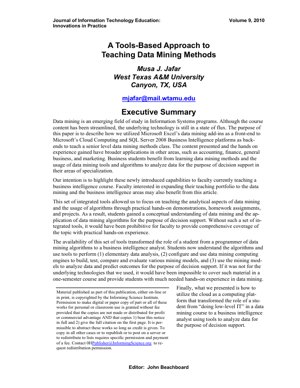
This paper presents a pedagogical innovation for teaching data mining within Information Systems and Business programs. Recognizing that the field is both conceptually dense and technologically fluid, the authors advocate for a tools-based approach that leverages accessible software to demystify complex algorithms. The core thesis is that by using Microsoft Excel's Data Mining Add-ins as a front-end, connected to robust back-ends like SQL Server 2008 and cloud computing platforms, educators can shift the student's role from low-level algorithm programmer to high-value business intelligence analyst.
The method allows a one-semester course to provide comprehensive coverage of data mining concepts—including association, classification, clustering, and forecasting—while giving students practical, hands-on experience in model building, testing, and evaluation for decision support.
2. Pedagogical Framework & Core Methodology
The approach is built on a clear pedagogical shift: abstract theory must be grounded in practical tool usage to be effective for business students.
2.1 The Tools-Based Philosophy
The authors argue that requiring students to code algorithms from scratch creates an unnecessary barrier. Instead, the course focuses on:
- Conceptual Understanding: Grasping the purpose, assumptions, and outputs of algorithms like Decision Trees, Naïve Bayes, and Clustering.
- Tool Proficiency: Learning to configure, execute, and interpret results using industry-relevant tools (Excel Add-ins).
- Analytical Translation: Bridging the gap between model output and actionable business insight.
2.2 Technology Stack: Excel, SQL Server, Cloud
The implemented stack creates a scalable, accessible learning environment:
- Front-end (Excel Add-ins): Provides a familiar interface for data preparation, model selection, and visualization. It abstracts complexity while exposing key parameters.
- Back-end (SQL Server 2008 BI Suite): Handles the heavy computational lifting of algorithm execution on potentially large datasets.
- Platform (Cloud Computing): Eliminates local infrastructure constraints, allowing students to access powerful computing resources on-demand, mirroring modern BI practices.
3. Course Implementation & Student Outcomes
3.1 Curriculum Structure & Hands-on Components
The course is structured around a cycle of theory, demonstration, and application:
- Lectures: Introduce the algorithm's logic and business use case (e.g., market basket analysis with Association Rules).
- Live Demonstrations: Instructor uses the tool stack to build and evaluate a model on sample data.
- Homework Assignments: Students replicate the process on provided datasets, adjusting parameters and interpreting results.
- Capstone Project: Students source or are given a business-oriented dataset (e.g., customer churn, sales forecasting) to define a problem, apply appropriate mining techniques, and present insights.
3.2 Measured Learning Outcomes
The paper reports qualitative success metrics. Students progressed through three core competencies:
Student Role Transformation
From: Programmer focused on algorithm implementation syntax.
To: Analyst focused on business problem definition, model selection, and insight generation.
Specifically, students learned to: (1) perform elementary data analysis and preparation, (2) configure computing engines to build, test, and compare multiple mining models, and (3) use validated models to predict outcomes and support decisions.
4. Technical Analysis & Framework
4.1 Core Data Mining Algorithms Covered
The course covers foundational algorithms, each mapped to a business question:
- Classification (Decision Trees, Naïve Bayes): "Will this customer churn?"
- Clustering (K-Means): "How can we segment our customer base?"
- Association Rules (Apriori): "What products are frequently bought together?"
- Forecasting (Time Series): "What will our sales be next quarter?"
4.2 Mathematical Foundations
While tools abstract implementation, understanding the core math remains crucial. For instance, the Naïve Bayes classifier is grounded in Bayes' Theorem:
$P(A|B) = \frac{P(B|A) \, P(A)}{P(B)}$
Where, in a spam detection example, $A$ represents the class ("spam" or "not spam") and $B$ represents the features (words in the email). The "naïve" assumption is the conditional independence of features. Similarly, the K-Means clustering objective function, which the tool optimizes, is:
$J = \sum_{i=1}^{k} \sum_{\mathbf{x} \in S_i} \|\mathbf{x} - \mathbf{\mu}_i\|^2$
where $k$ is the number of clusters, $S_i$ are the data points in cluster $i$, and $\mathbf{\mu}_i$ is the centroid of cluster $i$.
5. Critical Analysis & Industry Perspective
Core Insight: Jafar's paper isn't just a teaching guide; it's a strategic blueprint for closing the crippling gap between academic data science theory and the tool-driven reality of the modern business intelligence (BI) workplace. The real innovation is recognizing that for business majors, the value isn't in building the engine, but in expertly driving it to a destination (a decision).
Logical Flow: The argument is compellingly pragmatic. The field is in flux (true), coding is a barrier (true for this audience), and Excel is ubiquitous (undeniable). Therefore, leveraging Excel as a gateway drug to advanced BI and cloud platforms is a logical, low-friction path to competency. It mirrors the industry's own shift from custom-coded solutions to integrated platforms like Microsoft's Power BI, Tableau, and cloud ML services (AWS SageMaker, Google AI Platform). As the seminal work on accessible ML, "A Few Useful Things to Know about Machine Learning" (Domingos, 2012), argues, the "knowledge" often lies not in the algorithm's code but in the applied understanding of its biases and outputs—exactly what this course cultivates.
Strengths & Flaws: The strength is its practical brilliance. It solves a real curriculum problem and aligns perfectly with industry needs for "analysts who can ask the right question of the right tool." However, the flaw is its potential to create a "black box" dependency. Students might learn which button to press for a decision tree but remain vague on what entropy or Gini impurity actually measures, risking misapplication. This contrasts with deeper pedagogical approaches in CS, like those detailed in the classic "Data Mining: Concepts and Techniques" (Han, Kamber, Pei, 2011), which emphasize algorithmic internals. Furthermore, tying the curriculum tightly to a specific vendor stack (Microsoft) risks rapid obsolescence, though the core philosophy is transferable.
Actionable Insights: For educators, the mandate is clear: Tool-first pedagogy is no longer a compromise; it's a necessity for business programs. The course design should be replicated, but with critical augmentations: 1) Include mandatory "under-the-hood" modules using open-source platforms like Python's scikit-learn to demystify the black box, following the example set by widespread MOOC curricula. 2) Build case studies around tool-agnostic CRISP-DM or KDD process frameworks to ensure methodological rigor transcends the specific software. 3) Integrate ethics and interpretability discussions—topics paramount in modern AI/ML, as highlighted by research from institutions like the Stanford Institute for Human-Centered AI—since easy-to-use tools can also make it easy to produce misleading or biased models.
6. Future Applications & Directions
The tools-based approach has significant expansion potential:
- Integration with Modern BI/AI Platforms: The curriculum can evolve from Excel Add-ins to include hands-on modules with Power BI, Tableau Prep, and cloud AutoML services (e.g., Google Cloud AutoML, Azure Machine Learning studio), which represent the next generation of analyst-friendly tools.
- Cross-Disciplinary Projects: This framework is ideal for cross-functional courses partnering business students with marketing, finance, or supply chain management peers, applying data mining to real departmental datasets.
- Focus on MLOps Lite: Future iterations could introduce concepts of model deployment, monitoring, and lifecycle management using simplified pipelines, preparing students for the full model operationalization process.
- Emphasis on Ethical AI & Explainability (XAI): As tools make powerful models more accessible, curriculum must expand to teach students how to audit for bias (using toolkits like IBM's AI Fairness 360) and explain model outcomes, a critical skill highlighted in the EU's AI Act and similar regulations.
7. References
- Jafar, M. J. (2010). A Tools-Based Approach to Teaching Data Mining Methods. Journal of Information Technology Education: Innovations in Practice, 9, IIP-1-IIP-9.
- Domingos, P. (2012). A few useful things to know about machine learning. Communications of the ACM, 55(10), 78-87.
- Han, J., Kamber, M., & Pei, J. (2011). Data Mining: Concepts and Techniques (3rd ed.). Morgan Kaufmann.
- Tan, P. N., Steinbach, M., & Kumar, V. (2006). Introduction to Data Mining. Pearson Education.
- Wirth, R., & Hipp, J. (2000). CRISP-DM: Towards a standard process model for data mining. Proceedings of the 4th International Conference on the Practical Applications of Knowledge Discovery and Data Mining (pp. 29-39).
- Stanford Institute for Human-Centered Artificial Intelligence (HAI). (2023). The AI Index Report 2023. Retrieved from https://aiindex.stanford.edu/report/