Table of Contents
Global Investment (2021)
$24.4B
Estimated worldwide investment in quantum technology.
US National Quantum Initiative
$1.2B
Appropriated over five years.
1. Introduction & Overview
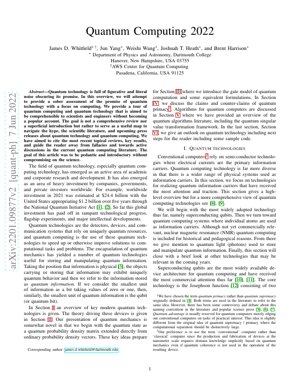
This article provides a technical, yet accessible, map to navigate the rapidly evolving and often hyped landscape of quantum computing. It aims to bridge the gap between popular accounts and dense academic reviews, offering a sober assessment of the field's promise, grounded in current scientific literature. The authors position quantum computing as a subset of quantum technologies, which are defined as systems leveraging uniquely quantum resources like superposition and entanglement.
Core Insight: The field is characterized by significant global investment and technological progress, but also by noise and exaggerated claims that require careful parsing.
2. Quantum Technologies
Unlike classical computing's reliance on semiconductor technology, quantum computing utilizes a diverse array of physical systems to carry quantum information (qubits).
2.1 Superconducting Qubits
Currently the most widely adopted and commercially advanced architecture. The core component is the Josephson Junction, which enables the creation of artificial atoms with controllable quantum states. This platform has led to processors with 50+ qubits from companies like Google and IBM.
2.2 Atomic Qubits
This category includes trapped ions and neutral atoms. Trapped ions (used by companies like IonQ) offer long coherence times and high-fidelity gate operations. Neutral atoms in optical lattices are a promising scalable approach, leveraging laser cooling and trapping techniques.
2.3 NMR Quantum Computing
Nuclear Magnetic Resonance uses the spins of atomic nuclei in molecules as qubits. While not scalable for large-scale computation due to signal strength issues, it has been historically crucial for demonstrating fundamental quantum algorithms and principles in a controlled, ensemble-based setting.
2.4 Photonic Qubits
Uses particles of light (photons) to encode quantum information. Key advantages include inherent mobility for quantum communication and low decoherence. Challenges involve generating and detecting single photons reliably and performing deterministic quantum gates.
2.5 Other Emerging Technologies
Includes topological qubits (theorized to be inherently fault-tolerant), silicon spin qubits (leveraging semiconductor manufacturing), and diamond NV centers. These are in earlier stages but represent important research directions.
3. Theoretical Foundations
The paper presents quantum mechanics from the perspective of information theory, emphasizing the "physicality of information."
3.1 Quantum State & Density Matrix
A novel pedagogical approach is taken by introducing the quantum state as a density matrix $\rho$, which generalizes the classical probability vector. For a pure state $|\psi\rangle$, the density matrix is $\rho = |\psi\rangle\langle\psi|$. For mixed states, it is a statistical ensemble: $\rho = \sum_i p_i |\psi_i\rangle\langle\psi_i|$, where $\sum_i p_i = 1$.
3.2 Qubits and Quantum Information
The fundamental unit is the qubit. Unlike a classical bit (0 or 1), a qubit state is a superposition: $|\psi\rangle = \alpha|0\rangle + \beta|1\rangle$, where $\alpha$ and $\beta$ are complex amplitudes satisfying $|\alpha|^2 + |\beta|^2 = 1$. Measurement probabilistically collapses the state to $|0\rangle$ or $|1\rangle$.
4. Models of Quantum Computation
4.1 The Gate Model
The most common model, analogous to classical digital circuits. Computation proceeds by applying a sequence of quantum gates (unitary operations) to an initial set of qubits, followed by measurement. Universal quantum computation can be achieved with a small set of gates (e.g., Hadamard, CNOT, T gate).
5. Quantum Primacy & Claims
The paper discusses the contentious concept of "quantum primacy" (or supremacy), defined as a quantum computer performing a task infeasible for any classical computer. It references key experiments like Google's 2019 "Sycamore" experiment, which claimed primacy by sampling the output of a random quantum circuit. The section likely guides the reader through the ensuing debates about benchmarking, classical simulation algorithms, and the practical utility of such tasks.
6. Quantum Algorithms
Provides an overview of the algorithmic landscape beyond Shor's and Grover's algorithms.
6.1 Quantum Singular Value Transformation
Highlights the Quantum Singular Value Transformation (QSVT) as a powerful unifying framework. QSVT provides a systematic way to construct a wide array of quantum algorithms by applying polynomial transformations to the singular values of a block-encoded matrix. Many famous algorithms (e.g., Hamiltonian simulation, quantum linear systems solvers) can be viewed as special instances of QSVT.
7. Outlook & Future Directions
The conclusion points readers toward next steps, including engaging with current literature and sample code. It emphasizes the transition from foundational physics to engineering-scale challenges: error correction, fault tolerance, increasing qubit count and quality (coherence times, gate fidelities), and developing "killer app" algorithms for near-term intermediate-scale quantum (NISQ) devices.
8. Critical Analysis & Expert Insights
Core Insight: Whitfield et al.'s 2022 overview is a necessary antidote to the rampant hype surrounding quantum computing. Its greatest value lies not in presenting new research, but in its curatorial and pedagogical stance—acting as a "sherpa" for technical professionals navigating a field obscured by both literal quantum noise and figurative market noise. The authors correctly identify the central tension: monumental global investment ($24.4B in 2021) driving genuine progress, versus a narrative often outpacing technical reality.
Logical Flow & Strengths: The paper's structure is logically impeccable. It builds from hardware (Section I) to theory (Section II) to computational models (Section III) and finally to algorithms and claims (Sections IV-V). This mirrors the hardware-software stack of the field itself. A key strength is its focus on modern frameworks like the Quantum Singular Value Transformation (QSVT), moving beyond the textbook staples of Shor and Grover. This aligns with cutting-edge research, as seen in Gilyén et al.'s seminal 2019 paper, which positioned QSVT as a grand unification theory for quantum algorithms. The authors' decision to use the density matrix formulation from the outset is pedagogically shrewd, as it naturally handles both pure and mixed states—the latter being the unavoidable reality in noisy, real-world systems.
Flaws & Omissions: While comprehensive, the paper's scope necessitates omissions. The treatment of quantum error correction—the linchpin for scalable, fault-tolerant quantum computing—is likely brief. Given its critical importance, as underscored by the roadmap from the Quantum Economic Development Consortium (QED-C), this deserves deeper emphasis. Furthermore, while it mentions the debate around "quantum primacy," a more incisive analysis could tie this directly to the lack of clear commercial benchmarks. Unlike classical computing's Moore's Law, quantum lacks a universally accepted metric for practical utility. The paper also underplays the fierce competition among qubit modalities. While superconducting qubits lead in qubit count, trapped ions hold the record for gate fidelities, and photonics dominates quantum networking—a strategic landscape akin to the early days of classical computing architectures.
Actionable Insights: For investors and CTOs, this paper provides a critical lens: prioritize teams with a sober, physics-grounded understanding of error rates and scalability, not just qubit numbers. The reference to sample code is a crucial directive for engineers: the field is now accessible via cloud platforms (IBM Quantum, Amazon Braket). Hands-on experimentation is the best hype filter. The discussion on QSVT signals where algorithmic research is headed; businesses should monitor applications in quantum machine learning and quantum simulation for chemistry and materials science, areas highlighted by organizations like the Berkeley Lab's Advanced Quantum Testbed. The ultimate takeaway is that the "quantum winter" narrative is false, but the timeline to transformative, error-corrected quantum computers remains long. The near-term opportunity lies in hybrid quantum-classical algorithms and exploring quantum advantage for specific, valuable problems on NISQ devices, a strategy actively pursued by companies like Zapata Computing and QC Ware.
9. Technical Details & Mathematical Framework
Density Matrix Formalism: The state of a quantum system is described by a density operator $\rho$ acting on a Hilbert space $\mathcal{H}$. It is positive semi-definite ($\rho \geq 0$) and has trace one ($\text{Tr}(\rho)=1$). The expectation value of an observable $O$ is given by $\langle O \rangle = \text{Tr}(\rho O)$.
Quantum Gates as Unitaries: Evolution of a closed quantum system is described by a unitary transformation: $\rho \rightarrow U\rho U^\dagger$. A key single-qubit gate is the Hadamard: $H = \frac{1}{\sqrt{2}} \begin{pmatrix} 1 & 1 \\ 1 & -1 \end{pmatrix}$, which creates superposition. A key two-qubit gate is the CNOT (controlled-NOT), which entangles qubits.
Quantum Circuit Diagram (Conceptual): A typical algorithm, like the Quantum Fourier Transform (QFT), is represented as a sequence of gates applied to wires (qubits). The QFT on $n$ qubits uses a series of Hadamard and controlled phase gates ($R_k$), demonstrating a structure that provides an exponential speedup over the classical FFT for certain applications.
10. Analysis Framework & Case Example
Case: Assessing a "Quantum Primacy" Claim
1. Define the Task: Identify the computational task (e.g., Random Circuit Sampling - RCS).
2. Classical Baseline: Establish the best-known classical algorithm's runtime and resource requirements (e.g., using tensor network contractions or supercomputers like Summit).
3. Quantum Implementation: Specify the quantum processor's characteristics (# of qubits, gate fidelity, connectivity, circuit depth).
4. Verification: How is the quantum output verified? (Cross-entropy benchmarking against classical simulation for small instances).
5. Utility & Scalability: Does the task have known practical applications? Does the quantum approach scale favorably with problem size?
Application: Applying this framework to Google's 2019 Sycamore experiment (53-qubit RCS) shows a claimed runtime advantage (~200 seconds vs. ~10,000 years for classical simulation). However, debates arose on steps 2 and 4, with improved classical algorithms later reducing the estimated classical runtime. The framework highlights that "primacy" is a moving target and underscores the importance of step 5—the search for tasks with both a quantum advantage and practical value.
11. Future Applications & Roadmap
Near-term (NISQ Era, next 5-10 years):
- Quantum Simulation: Modeling complex molecules for drug discovery (e.g., catalyst design for nitrogen fixation) and novel materials (high-temperature superconductors). Companies like Pasqal and Quantinuum are actively pursuing this.
- Quantum Machine Learning: Hybrid algorithms for optimization, sampling, and pattern recognition in finance, logistics, and AI. Research is ongoing to find genuine quantum advantage here.
- Quantum Sensing & Metrology: Ultra-precise measurements for navigation, medical imaging, and fundamental physics.
Long-term (Fault-Tolerant Era, 10+ years):
- Cryptanalysis: Shor's algorithm breaking RSA and ECC encryption, driving the need for post-quantum cryptography (standardization by NIST is underway).
- Large-Scale Quantum Simulation: Full-scale simulation of quantum field theories and complex biological processes.
- Unforeseen Algorithms: The most exciting applications may be those not yet conceived, leveraging the unique structure of quantum information.
Key Challenges: Building logical qubits from many error-prone physical qubits via quantum error correction (e.g., the surface code). Achieving high-fidelity operations at scale. Developing a robust quantum software stack and algorithms tailored to hardware constraints.
12. References
- National Quantum Initiative Act. (2018).
- Investment reports (e.g., McKinsey, 2021).
- Landauer, R. (1991). Information is physical.
- Preskill, J. (2012). Quantum computing and the entanglement frontier.
- Arute, F., et al. (2019). Quantum supremacy using a programmable superconducting processor. Nature, 574(7779), 505-510. (Google Sycamore)
- Gilyén, A., Su, Y., Low, G. H., & Wiebe, N. (2019). Quantum singular value transformation and beyond: exponential improvements for quantum matrix arithmetics. Proceedings of the 51st Annual ACM SIGACT Symposium on Theory of Computing. (QSVT Framework)
- Quantum Economic Development Consortium (QED-C). (2023). Quantum Computing Technical Landscape.
- Ladd, T. D., et al. (2010). Quantum computers. Nature, 464(7285), 45-53.
- Kjaergaard, M., et al. (2020). Superconducting qubits: Current state of play. Annual Review of Condensed Matter Physics, 11, 369-395.
- IBM Quantum. (2023). IBM Quantum Development Roadmap.
- IonQ. (2023). Technical Brief.
- Nielsen, M. A., & Chuang, I. L. (2010). Quantum Computation and Quantum Information: 10th Anniversary Edition. Cambridge University Press.