Table of Contents
1. Introduction
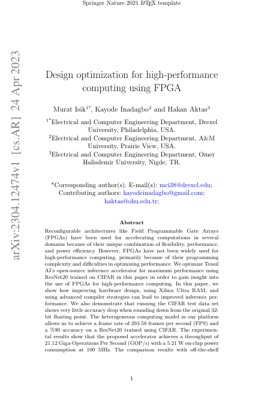
Field Programmable Gate Arrays (FPGAs) offer a compelling blend of flexibility, performance, and power efficiency for computational acceleration. However, their adoption in High-Performance Computing (HPC) has been hindered by programming complexity and performance optimization challenges. This paper addresses this gap by presenting a comprehensive optimization of Tensil AI's open-source inference accelerator. Using ResNet20 trained on the CIFAR dataset as a benchmark, the research demonstrates how synergistic improvements in hardware design, memory utilization (Xilinx Ultra RAM), and compiler strategies can unlock significant inference performance on FPGAs, making them more viable for demanding HPC applications like real-time image processing.
2. Methodology & System Design
The core of this work is a multi-faceted optimization approach targeting the FPGA inference pipeline.
2.1 Hardware Design Optimization
The design leverages the parallel architecture of FPGAs to accelerate convolutional neural network (CNN) operations. Key optimizations include efficient mapping of ResNet20 layers to hardware resources, maximizing data reuse to minimize off-chip memory bandwidth, and exploiting pipeline parallelism within and across computational units. The use of Xilinx Ultra RAM blocks is highlighted as a critical factor for managing the on-chip memory requirements of intermediate feature maps efficiently.
2.2 Compiler Strategy & Precision
Advanced compiler techniques are employed to optimize the dataflow graph of ResNet20 for the target FPGA. A significant finding is the minimal impact on accuracy when quantizing from 32-bit floating-point to lower precision formats suitable for FPGA logic. This precision scaling is essential for reducing resource consumption (DSPs, LUTs) and increasing operational frequency, directly contributing to higher throughput.
2.3 Heterogeneous Computing Model
The platform employs a heterogeneous model where the FPGA acts as a co-processor for intensive CNN inference tasks. This model allows the host CPU to handle control-flow and I/O operations while the FPGA accelerates the compute-bound tensor operations, leading to an efficient division of labor.
Key Performance Metrics
Throughput: 21.12 GOP/s
Power: 5.21 W (on-chip)
Frame Rate: 293.58 FPS
Accuracy: ~90% on CIFAR-10
3. Experimental Results & Performance
3.1 Throughput & Power Metrics
The optimized accelerator achieves a throughput of 21.12 Giga-Operations Per Second (GOP/s) while consuming only 5.21 W of on-chip power at a clock frequency of 100 MHz. This low power consumption is a hallmark of FPGA efficiency compared to GPUs.
3.2 Accuracy & Frame Rate
Despite aggressive optimization, the system maintains a high accuracy of approximately 90% on the CIFAR-10 test set, demonstrating the effectiveness of the precision scaling strategy. The end-to-end system achieves a real-time inference rate of 293.58 frames per second (FPS) for ResNet20.
3.3 Comparative Analysis
The paper claims "obvious advantages in terms of energy efficiency" when compared to off-the-shelf devices and other state-of-the-art implementations. This suggests the design achieves a superior performance-per-watt ratio, a critical metric for edge computing and data center deployments.
4. Technical Deep Dive
4.1 Mathematical Foundations
The core computation accelerated is the convolution operation, fundamental to CNNs. For a 2D convolution with input feature map $I$, kernel $K$, and output $O$, the operation at position $(i, j)$ is defined as: $$O(i, j) = \sum_{m} \sum_{n} I(i+m, j+n) \cdot K(m, n) + b$$ where $b$ is the bias term. The FPGA optimization involves unrolling these summation loops spatially across parallel multiply-accumulate (MAC) units and temporally via deep pipelines to maximize hardware utilization. The energy efficiency gain stems from the FPGA's ability to implement this exact, custom dataflow without the overhead of a general-purpose instruction set architecture.
4.2 Analysis Framework & Case Study
Framework: The optimization follows a structured co-design loop: 1) Model Analysis (Profiling ResNet20 layers), 2) Architectural Mapping (Assigning layers to hardware modules), 3) Precision Exploration (Quantizing weights/activations), 4) Memory Planning (Mapping to Block RAM/Ultra RAM), and 5) Performance-Power Trade-off Analysis.
Case Study - The Bottleneck Layer: Consider a convolutional layer with large feature maps. A naive implementation would become memory-bandwidth bound. The paper's approach would analyze this layer's data access pattern, use the compiler to schedule operations to maximize data locality, and map intermediate buffers to high-bandwidth Ultra RAM. This transforms the bottleneck from memory access to compute, which can be parallelized efficiently on the FPGA fabric.
5. Critical Analysis & Industry Perspective
Core Insight: This paper isn't just about making an FPGA accelerator fast; it's a blueprint for systematically dismantling the traditional barriers to FPGA adoption in HPC. The real breakthrough is the demonstrated synergy between a high-level AI toolchain (Tensil) and low-level hardware optimization, proving that the "programmability gap" can be bridged without sacrificing the raw efficiency that makes FPGAs attractive in the first place.
Logical Flow: The argument progresses logically from identifying the problem (HPC needs efficiency, FPGAs are hard to program) to presenting a holistic solution. It moves from hardware tweaks (Ultra RAM) to toolchain innovations (compiler strategies) and finally validates the approach with solid, end-to-end application metrics (FPS, accuracy). This mirrors the industry shift from isolated kernel acceleration to full-stack, domain-specific architecture design, as seen in projects like Google's TPU.
Strengths & Flaws: The strength is undeniable in the energy efficiency numbers—21 GOP/s at 5W is a compelling argument for edge deployment. However, the analysis is myopic. Using ResNet20 on CIFAR-10 is a toy problem by modern AI standards. Where's the stress test on ResNet-50/101 with ImageNet, or a vision transformer? The paper sidesteps the immense challenge of scaling this optimization methodology to billion-parameter models, where memory hierarchy and data movement become exponentially more complex. Furthermore, it leans heavily on Xilinx-specific features (Ultra RAM), raising questions about portability and vendor lock-in—a significant concern for long-term HPC infrastructure.
Actionable Insights: For product teams, the takeaway is clear: stop thinking of FPGAs as just hardware. The winning strategy is to invest in or partner with software stacks (like Tensil AI, Xilinx Vitis AI, or Intel OpenVINO) that raise the abstraction level. The primary ROI will come from co-designing the algorithm and the hardware target from day one, especially for embedded vision and signal processing. For researchers, the next frontier is automating this co-design process for larger, more diverse models and exploring open-source, vendor-agnostic intermediate representations (like MLIR) to break the toolchain dependency highlighted here.
6. Future Applications & Research Directions
The principles demonstrated have broad applicability beyond image classification. Future directions include:
- Scientific Computing: Accelerating physics simulations (e.g., finite element analysis, molecular dynamics) where custom numerical precision and dataflow can offer advantages over GPUs.
- Next-Gen AI Models: Optimizing transformers for NLP and vision, focusing on efficient attention mechanism deployment.
- Hyper-Scale Edge AI: Deploying federated learning or multi-modal models (audio-vision) on low-power FPGA platforms at the network edge.
- Hardware-Software Codesign Automation: Research into AI-driven tools that automatically explore the design space (precision, parallelism, memory) for a given model and target FPGA, moving beyond manual optimization.
- Integration with Emerging Memory: Exploring designs that leverage HBM (High Bandwidth Memory) on modern FPGAs to tackle the memory wall for very large models.
7. References
- Isik, M., Inadagbo, K., & Aktas, H. (2023). Design optimization for high-performance computing using FPGA. arXiv preprint arXiv:2304.12474.
- Jouppi, N. P., et al. (2017). In-datacenter performance analysis of a tensor processing unit. Proceedings of the 44th Annual International Symposium on Computer Architecture (ISCA).
- Zhu, J.-Y., Park, T., Isola, P., & Efros, A. A. (2017). Unpaired image-to-image translation using cycle-consistent adversarial networks. Proceedings of the IEEE International Conference on Computer Vision (ICCV). (CycleGAN reference for image processing context).
- Xilinx, Inc. (2023). Vitis AI Development Environment. Retrieved from https://www.xilinx.com/products/design-tools/vitis/vitis-ai.html
- TensorFlow Lite for Microcontrollers. (2023). Google. Retrieved from https://www.tensorflow.org/lite/microcontrollers (For edge AI framework context).